

I spotted several buds on 4/14, and this one was the first to open fully (picture taken 4/15).
My husband visited his parents today, and my mother-in-law sent some chourico home with him. I reheated the chourico and ate it on a hot dog bun with some ketchup. Yes, ketchup. I’m pretty sure that’s enough to get me excommunicated, or whatever they do to wives who don’t adapt to the proper Portuguese ways.
P.S. For the record, I wanted to add a cedilla to “chourico,” but I couldn’t figure out how to do that. I am not loving this version of WordPress!
It’s a beautiful night for listening to the peepers.
Quote of the day:
I hope it starts pouring. I don’t want to get soaked. I just want everyone to stay away!
—Spoken by the cart-return guy at the local grocery store
Thanks to Stop & Shop’s labor strike, our local grocery store was a mob scene today. It would seem that the people in my town prefer to wait in lines rather than cross picket lines. That’s laudable, I have to say, but I also agree with the cart-return guy. I wish everyone would stay away. Our local grocery store is horrifically expensive. Those of us who shop there regularly do so because it’s convenient. Take away the convenience and the prices are unbearable, and today the extra shoppers spoiled the convenience. I know those shoppers had to go somewhere. I just wish it hadn’t been there!
I’m no expert on S&S or on labor unions, but it sounds to me like S&S posted massive profits then tried to cut their workers’ pay and benefits. That’s unfair, and though it may have become par for the course in the Profits-Over-People economy that our government is currently sponsoring, it’s still wrong. Very wrong.
As a child, I remember going to S&S with my mother. As an adult, I have shopped in S&S and Giant stores in many places over the years. Though I shop at a variety of stores, S&S is where I go for my big grocery shopping trips. But I will give the chain up if they can’t treat their employees better. Really, I have no patience left for this kind of bullshit. Just a little farther down the road are Target, Whole Foods, Aldi, Market Basket, Seabra, and others. Don’t make me have to go there!
The good news is that if I force myself to sit at my desk, where I won’t be able to stop myself from bingeing on social media, eventually I will become so disgusted with myself that I’ll do some writing. That’s also the bad news. There really ought to be a better way to get myself to write
The problem with writing while listening to soundtrack music is that the grandeur of the music does not always match the writing. I’m listening to the soundtrack to Inception. It’s big, powerful music. While listening to it, I could be writing about yesterday’s lunch and that lunch would seem so incredibly important—“It was curried chicken, by God! And my life has never been the same since!”
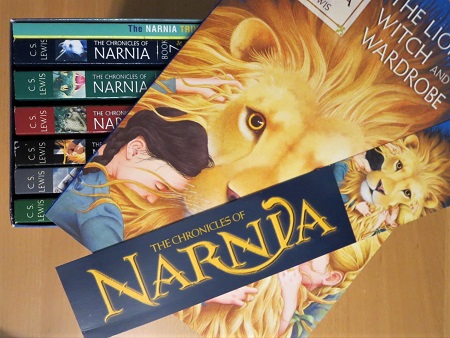
Mail Delivery!
Yes, more books came today in the mail today, but I feel justified in having bought these. I have been needing a replacement set of Narnia books for a long time. Now that my kids are old enough to enjoy the series, I thought I should have a readable set here for them. Not that my old ones were completely unreadable, but they were all nastily foxed and tanned, plus Prince Caspian‘s spine had completely failed and pages were falling out of it. I chose this particular set because the cover art looked good, and it came with a trivia book (and also a cute bookmark, as I discovered when I pulled out The Lion, the Witch, and the Wardrobe). These are reading copies, appropriate for the rough handling they’re likely to get from children. Someday I still hope to buy a quality set of hardback copies.
Me: I have too many books. I’m not going to order any more of them. No more books will be arriving in the mail.
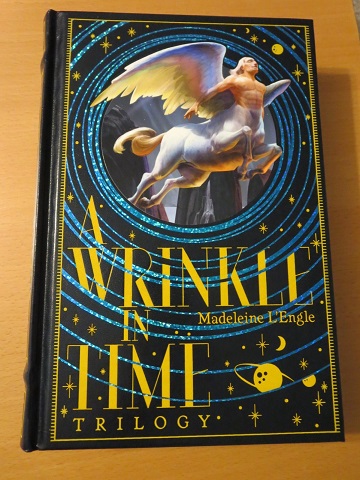
Mail Delivery!
Also Me: OK, so I’m a sucker for pretty books.
Dear Children,
Just a few days ago the two of you secretly worked together to set up a Story Nest as a surprise for me. I was tired, so I let you do all the reading. It was wonderful to just relax in the Nest and listen to you read the books that I used to read to you. All those years of bedtime reading really paid off.
As for your individual reading, Livia has been working her way through huge quantities of books from both the public library and my personal library. But, for all that she’s a voracious reader who stays up far too late reading, she’s choosy about what she reads, and understandably so (though it’s hard on me, since I have so many favorite books that I’d like to share!). She likes my Roald Dahl and Edward Eager books, but she will not read any books about things she does not like, so no princesses (The Ordinary Princess by M.M. Kaye), dolls (Magic Elizabeth by Norma Kassirer), ghosts (The Children of Green Knowe by L.M. Boston), or mysteries (Nancy Drew), and it nearly broke my heart when she said she didn’t want to read Dodie Smith’s The One Hundred and One Dalmatians simply because she doesn’t like dogs. I don’t particularly like dogs either, but it’s an adorable book, so I made a bet with her. Our bet is that if she reads it and absolutely hates it, I’ll give her two bucks to pay for her time. If she likes it, I’ll get the satisfaction of having convinced her to read another great book.
Marshall has also been reading a lot, but at a slower, appropriately Marshallesque pace. He recently finished Charlie and the Chocolate Factory, and now he’s reading the sequel. Yesterday he was the one who was still awake and reading late into the night. Tsk, tsk. You might both do well to read a little less and sleep a little more! I have never stayed up too late reading, so I can say that 😉
Last week was the school’s art show. This year Marshall was the one with art on display, and I got a great picture of him next to the snowman he had created. Both of you were thrilled again by the large assortment of cookies. But in addition to the free cookies, we seem to have picked up a free virus. We all came down with a cold a few days later, and your father, in particular, has been miserable since. Poor Daddy.
Your fencing lessons have been a big success. You graduated from the Beginner level yesterday (and you got special pins to mark the occasion). The classes have been so good for you, and you enjoy them so much, that we’ve signed you up for the Intermediate level.
You also started music lessons a few weeks ago. Livia practices nearly every day without being told to. She doesn’t always practice the pieces assigned to her, because she would rather play things such as “Baby Shark” and the theme from “Godzilla,” but she enjoys playing, and that’s important. Her musical ability is obvious, and she has such enthusiasm. It is a pleasure to watch her learn. Marshall usually has to be strong-armed into practicing, and he hardly does enough, yet somehow by the time his next lesson rolls around he has miraculously improved. I am convinced that he has a vast reservoir of musical talent that he only displays when he feels like it. After all, who already knew how to read written music, and who taught his sister how to play recorder, and who figured out how to play the “Godzilla” theme on the keyboard? Marshall did! So you’re both making excellent progress, each in your own way.
And I should not fail to mention that both of you showed improvement on your latest report cards.
You are growing as readers, artists, athletes, musicians, and scholars, and I am so proud of you both.
Love,
Mom
I took this week off from work. Inspired by my success in the limerick contest, I wanted to try writing full-time. I thought if I could just repeat the focus I’d found for the limericks, I’d be able to accomplish something.
Habit’s difficult, though. A lifetime of procrastination is not so easily overcome, especially not without the aid of deadline pressure. Monday, Tuesday, and Wednesday flew by while I goofed off on social media.
By last night, I was furious with myself. I left a note in Scrivener so I’d see it first thing in the morning. It said in giant, bold letters: Put on your headphones. Turn on the music. Write.
It was good advice, and I thought I’d better follow it. So this morning I started writing about how I might take the lessons I’ve learned at work and apply them to personal creative endeavors. I accomplish so much for the sake of my employers. There’s no reason I can’t do the same for myself.
Next, I tackled the issue that’s been holding me up for a while: form. If you’re going to write a rhyme, it’s easiest to start with a form, because then you know exactly how many rhyming words you need and how they will work together. The problem was that I kept looking in books for a form, but I wasn’t finding it. So today I toyed around with different arrangements of rhythm and meter, looking for an interesting arrangement that’s big enough to include a cute visual for each rhyme without being overly long.
I believe I have found a working form. It might be too long. We’ll see. At least it’s a starting point. It gives me a direction in which to proceed. That’s all I wanted, and I’m calling today’s writing a success.
© 2007-2026 Author of Blue-Footed Musings All Rights Reserved