This rather scary plant (look at all those thorns!) is a type of wildflower that I first spotted a couple of years ago but never got around to identifying. When I saw it this year, it was late in the day, so this is not a good picture of the flowers. It does give a good idea of the plant’s overall appearance, though.
Seeing this plant’s flowers and leaf structure, I suspected that it was a nightshade. When I later saw its fruit, I was almost certain.
This is a picture from 2017. It’s two years old, so I can’t be 100% sure, but I think it’s a picture of the fruit that this kind of plant produces.
After researching this plant, I believe that it is horse nettle, which is indeed a nightshade. Horse nettle is not a very nice plant. Not only is it thorny, but it’s also poisonous. Horse nettle often ends up on lists of poisonous lookalikes because the fruit looks tomato-y (one of its common names “devil’s tomato”). Don’t let the fruit fool you. You do not want to eat any part of this plant, and neither does your horse, if you have one.
Good things about Writing for the Machine (a.k.a. social media):
It’s taught me to write and edit faster. It’s crazy to spend a lot of time on a piece of text that has a lifespan measured in hours, so I try not to do that. I write the comment, proofread it, then make a quick decision to delete or to post.
It’s taught me to be more concise. The Twitter character limit isn’t as restrictive as it used to be, but it still forces me to leave out the weakest words. Adverbs are the first to go, followed by conjunctions and adjectives.
It’s reminded me how perilous cliches can be. We’ve all heard the advice “Avoid cliches like the plague,” but the temptation to use our favorites is still strong. Where the danger lies is that we never know which ones the reader has begun to react negatively to. On social media, the most popular ones soon become the most cringe-worthy. I can’t stand the phrases “Thanks for coming to my TED Talk,” “Fixed it for you,” and “Let that sink in for a minute.” It also drives me nuts to see periods used for emphasis (“Fixed. It. For. You.”). I’ve seen all of these too many times. They’re not witty or fun or interesting anymore. They’re smug and lazy.
Bad things about Writing for the Machine:
I might have learned to write faster, but keeping up with social media still eats up a lot of my day. I have better things to do with my time.
Having learned to write more concisely and to avoid cliches can only be counted as beneficial if I apply those skills to other writing endeavors, which I don’t.
Social media is often an angry, depressing place. There are better sources for news, better ways to socialize, and better methods for expressing my political views.
Every once in a while I invent a new type of puzzle. My most recent creation was just published for the first time a few weeks ago. I haven’t seen it yet, so I don’t even know how the finished product looks, but yesterday I received an e-mail from someone who had written in to say that she really liked the new puzzle and that she hopes to see it again. I don’t get a lot of feedback, so this was especially nice to hear. It also made me look very good in the eyes of the higher-ups, who love this kind of feedback, and it pretty much guarantees that my puzzle will be used again in the future. So, thank you Random Puzzle Solver. You made my week!
I’m not going to get very far with cataloguing wildflowers if I keep dwelling on the ones I’ve already covered, but I did say that I’d look for “thumbprints” the next time I saw lady’s thumb. And the next time was this morning, because it grows in my yard. Or does it? I looked at several dozen leaves and not a single one had the mark on it.
No thumbprint!
While I was researching smartweeds the other day, I believe what I read was that while some other smartweeds occasionally have the mark, the defining characteristic of lady’s thumb is that most of its leaves do have it. This plant in my yard is therefore probably not lady’s thumb.
So what is it? Perhaps the clue is to be found where the leaf meets the stem. The stem isn’t hairy or sticky (so I don’t think this is Pennsylvania smartweed, another lady’s thumb lookalike), but there are long bristles sticking out. You can see them more clearly here.
Some of the flowerheads are also quite bristly.
Here you can see what the flowers look like when they’re open.
According to the Connecticut Botanical Society, what I probably have here is long-bristled smartweed (a.k.a. Oriental lady’s thumb), which they say can be identified by the “papery sheaths around the leaf joints with long, fine bristles at the top.” So, thanks to the alternative name, I can still call it “lady’s thumb.” Convenient!
But just in case you were wondering what the mark looks like, here you go.
These leaves have the lady’s thumb mark. I took this picture this afternoon while walking along the nature trail at the library. Is this plant lady’s thumb? I don’t know, but that’s what I’m going to call it.
Now, remember when I said that dwelling on previously covered flowers was going to keep me from cataloguing other wildflowers? How wrong I was! Because I’ve got two more to squeeze into this post, thanks again to the Connecticut Botanical Society (to which I am sending tons and tons of psychic gratitude).
While on the webpage for long-bristled smartweed, I clicked on the link to the next flower from the same (buckwheat) family, thinking it might take me to another smartweed that I could use as a comparison. Instead, the link took me to this white flower, arrow tearthumb. Doesn’t it look a lot like this mystery flower I photographed earlier this month?
I hadn’t yet been able to identify this flower, but now I think it must be arrow tearthumb.
And I kept clicking on that link until I got to another plant I’d seen before, Japanese knotweed. I have noticed this stuff growing all over the place lately. I even took a picture of it today, thinking I should finally figure out what it was.
This plant is probably Japanese knotweed. I read that the knotweeds are hard to tell apart, so as with the smartweeds, I’m not going to try. I’m simply going to call it “Japanese knotweed,” safe in the knowledge that, for my intents and purposes, that identification is close enough.)
Japanese knotweed is apparently quite the invasive plant. That’s unfortunate, but at least I know what to call it now. It also has pretty flowers, and I especially love the seeds. I took a close-up picture of the seeds today, but it didn’t come out very well. I will try again on another day, and if the pictures come out nice, chances are you’ll see them!
I walked on a different path yesterday. I found many flowers, but most were types that I’d seen before. I was feeling a little disappointed, but just before my walk’s end, I spotted something new. This unfamiliar white flower was growing next to a familiar pink flower (lady’s thumb). My first thought was that the two plants looked related. But then, when I got home and searched through my handy-dandy field guide, though the book listed several related plants, none of them had white flowers that looked like this. How frustrating!
I tried the Internet, of course, but as it so often does, it got me turned around in the wrong direction. I was beginning to think that I wasn’t going to be able to identify this flower. Then I remembered that there was a good website for Connecticut wildflowers. We have many of the same plants here in Rhode Island, so it’s a good resource. I looked up “Connecticut wildflowers” and voila! My search engine presented me with the address for the Connecticut Botanical Society.
The Connecticut Botanical Society’s website is very useful. Browsing through all the white flowers took a while, but I found my plant, or at least its genus. I am certain now that my white flower is a smartweed, and as I had guessed, it is related to the lady’s thumb. I believe that it is mild water-pepper or another similar plant, such as dotted smartweed.
I am going to call it mild water-pepper and leave it that, rather than try to pinpoint the species more exactly. Years of plant identification have taught me that there are far more varieties of plants than most people realize. Even the plant that I called “lady’s thumb” might actually be a related plant, such as Pennsylvania smartweed. I am not interested in the extra work it would take to be absolutely certain. In some cases, it wouldn’t even be possible for an amateur such as myself, and usually, it seems to me, when species are very much alike, they are interchangeable in most ways. They are interchangeable for my purposes, anyway.
Regarding lady’s thumb, I had always wondered where its name came from. It doesn’t look very thumblike, does it? It turns out that the name is a reference to the leaf, which typically has a dark, thumbprint-like splotch on it. I have never noticed that feature before. I will look for it the next time I see this plant, and take pictures, of course!
I enjoyed my recent walks so much that I wanted to document all the wildflowers that I saw. There were so many, I don’t know if I will be able to get to them all. It may help to group related plants together, and with that thought in mind, here are the four clovers that I found along the walking trail.
Red Clover
Have you ever wondered why it is called “red clover” when it is so obviously purple?
White Clover
The place I see white clover most often is in lawns. A clover-studded lawn is a cheerful lawn. The only lawns I’ve ever seen that did not have clover in them were “chemical lawns,” green and uniformly thick with grass, but having little other life in them, and dependent on poisons to keep them that way. Let the clover grow, I say.
Rabbit-Foot Clover
This is a plant I identified a few years ago. I’ve only seen it a few times, but apparently it can be invasive, so perhaps I will see it more often in the future. As I was reading about this plant, it amused me that a website about Illinois wildflowers said, “It is rather unfortunate that Rabbit-Foot Clover is not native to North America, even though it is somewhat weedy, because its flowerheads are quite cute and appealing.” Its “furry” flowers are indeed cute. It occurs to me now, though, that I have not petted them them to find out if they are as soft as they look. I should try that the next time I see this plant.
Slender Bush Clover
When I spotted this unfamiliar plant, I thought it might be difficult to identify given that it has a similar look to so many other flowers. But I had just read that clovers are part of the pea family, and these flowers have that distinctive pea-flower shape. My Audubon field guide describes slender bush clover as “an upright stem with compound leaves and small crowded clusters of lavender to pink pea flowers in upper leaf axils,” with leaves that are “divided into 3 narrow blunt leaflets.” This picture was taken in the right range, season, and conditions for the plant, so I’m pretty confident that I have correctly identified it. Interesting fact: this is the only one of the four clovers in this post that is native to North America.
Today is the autumnal equinox, the first day of fall, which means my favorite season has officially begun. In celebration, I offer three “Farewell to Summer” pictures from my walks last week.
Seeds in the SunGold Turns to WhiteChicory at Day’s End
I spotted this peculiar hairy plant while out walking last week.
What on earth?
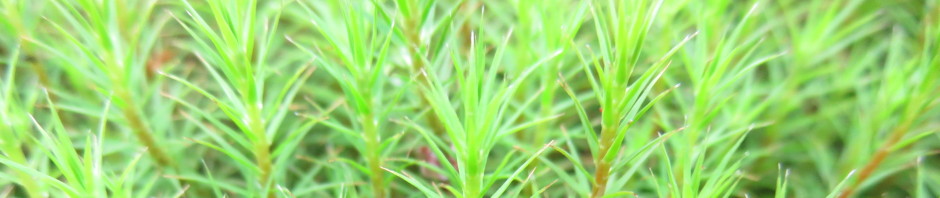
This was a tough plant to identify! I looked through my field guides multiple times. I ran numerous Internet image searches. Nothing looked exactly like this plant. I was beginning to get frustrated, but I refused to fail, and I did finally solve the mystery. The trick, for me, was to realize that it isn’t a shrub, that those hairy things are not flowers, and that this plant looks quite different when it’s in bloom.
Do you know what this Mystery Flower is? My best guess is in the comments.