(9/12)
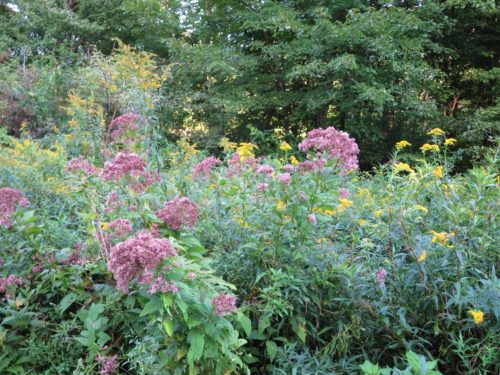
When I first saw Joe Pye weed this year, I initially confused it with milkweed, because the flowers are a similar color. It’s a tall plant, as milkweed is, and it grows in the same places. Otherwise, the two plants aren’t that similar. I will not make that mistake again.
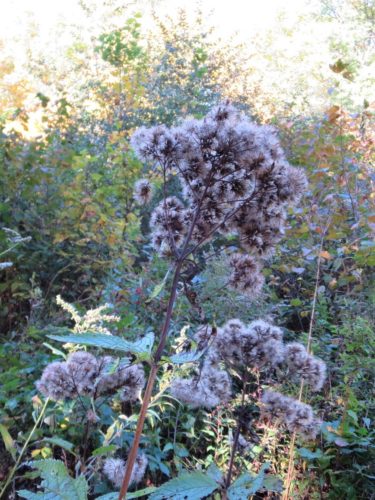
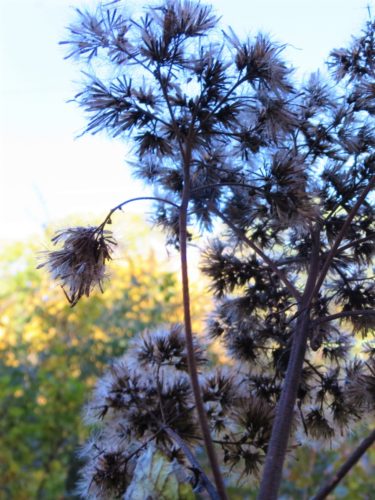
The seeds of Joe Pye weed bring a hint of chilliness to the autumn landscape.
(10/18)
Joe Pye weed is a popular plant among gardeners. When I did an Internet search on it, most of the hits were for gardening, rather than wildflower, websites. Among its positive attributes are that it’s pretty, unusually tall, attractive to pollinators, late-blooming, and easy to grow.
The derivation of the plant’s common name, according to some, is that there was a Native American sachem, born in the 1700s, who used the plant medicinally. His Christian name was said to be Joseph Pye. However, Merriam-Webster’s website lists the derivation as “unknown,” which is a red flag. A little more digging led me to the Phipps blog (Phipps Conservatory and Botanical Gardens in Pittsburgh), which gives a good sum-up of the story but also refers to it as a “legend.” I think that’s as close as we’re going to get to the truth about the name of this plant.
Pingback: Flower Catalog | Blue-Footed Musings