Random 7/17/2021

  • My New Yorker subscription has run out. I am surprisingly sad about this. Each issue is chock-full of good stuff, such as cartoons, crossword puzzles, and interesting articles. But, these things come at a cost. In terms of price, The New Yorker is ridiculously expensive. It also arrives weekly, which is far too frequently for me to keep up with it. It steals reading time that would otherwise go to Smithsonian and Rhode Island Monthly, leaving those publications neglected. So, I will probably have to settle for digital access. That is, unless I am offered another subscription at a no-brainer discount price, in which case all bets are off.
  • The weather is getting in the way of my walks. It always seems to be muggy, buggy, oppressively hot, and/or pouring. Though the skies have been mostly gray, there has been a bright side to the situation. The excessive rain has kept our stream running merrily along at a time when normally it would be dry. I am delighted by that.
  • Summer comes with bug bites. This has always been the case, and it always will be. Consequently I am willing to accept a certain number of them, barring tick bites, without complaint. But, lately I have been getting eaten alive, and unfortunately that affects my sleep, because the itching wakes me up in the middle of the night. The more bites I get, the worse my allergy to them gets, which means bigger welts and worse itching. I need to be a little more careful about what I wear outside, and when and where I walk. I may even have to consider using a mosquito repellent (if only it weren’t as repulsive to me as it is to mosquitoes!).
Posted in Uncategorized | 2 Comments

SITY: Low Light

It never fails. If I walk late, and especially if it’s cloudy, I always see things that need to be photographed. That’s what happened today. Of course, nothing photographs well under such low light, but I took pictures anyway, and I’m going to share them.

The first thing I noticed was that some of the black medick was looking kinda fuzzy. What? That can’t be. As we know from last year, the flowers turn into hard black seeds, not fuzzy ones. So I looked closer, and it was actually a small rabbit-foot clover plant, the first one I’ve ever found on my property.

Welcome, furry friend!

Then I spotted another one.

Wait, no. This is not a clover. This is a surprise caterpillar!

The caterpillar wasn’t the only critter around.

Beetle Doing a Split
Slug Being Sluggy

But these jewels are what really caught my eye.

Jeweled Jewelweed

I’d never given much thought to why the plant was called “jewelweed.” I guess I just assumed it was because of the brightly colored flowers. Several sources suggest that it’s actually either because of the way water beads up on the surface of the leaves or because of the silvery look that the leaves get when submerged. Apparently the leaves are water-repellent, which is why water beads on them, and they also have microscopic hairs that trap air, which is what causes that silvery look when leaves are submerged. But, it wasn’t beading or silveriness that made me take the picture. What interested me was how the water droplets had caught on the teeth of the leaves. I wonder if holding on to the drops that way could provide some benefit to the plant. I don’t know. In any event, it was pretty and worth photographing, even under such low light.

Posted in Local Flora and Fauna | Tagged , | 1 Comment

Reading Report: Middish-July 2021

I finished Be Buried in the Rain by Barbara Michaels, and I gave it the usual “Michaels B+.” It is the story of Julie Newcomb, a med student who goes to Virginia for the summer to take care of her elderly grandmother on their ancestral estate in Virginia. The skeletons of a young woman and a baby are found around the same time, and nobody knows who the bones belong to or how they got to where they were found, in the middle of the road, in a place called Dead Man’s Hollow, which runs through Julie’s family’s property. It becomes Julie’s mystery to solve. This book’s biggest flaws are only obvious in retrospect. Consequently, I enjoyed it quite a bit as I was reading it, but I am slightly disappointed by it now that it’s over. Getting to the end was pleasant, if a little unexciting, but then everything happened in a rush. The main character had a lot of repressed memories that she couldn’t recall until it was convenient for the plot, and that tarnished the resolution of the mystery. But, the last paragraph was eerie and so perfect that it made up for a lot of the problems elsewhere in the book. If only Michaels had managed to sustain an aura of suspense to match it! Add another fifty pages or a faster build to the climax, and it could have been a great book. Too late to fix it now, though. As published, Be Buried in the Rain is an enjoyable read but not a keeper.

I am close to finishing The Woman in Cabin 10 by Ruth Ware. Ruth Ware’s work is often compared favorably with Agatha Christie’s, which is why I decided to read this book. Christie was a great mystery writer because she had a knack for inventing memorable detectives and interesting scenarios that play fair with the reader. It didn’t hurt that she often set her stories in a time period that has a high nostalgia factor now. Her writing style is simple and comfortable, which is probably why it’s so popular, but it’s not otherwise noteworthy. I make these judgments after decades of reading and rereading almost all of her major works. I don’t have nearly as much experience with Ware’s books, so I can’t fairly compare the two writers. Judging by what I’ve read so far, Ware seems to have some of same knacks that Christie did, and I think her writing has a little more flair. But what strikes me most about The Woman in Cabin 10 is how intensely real it feels. If Ware can keep up this level of tension all the way to the end, then I will have to say that she is a great mystery writer, too.

I saw on the Tor website that Judith Tarr was rereading Andre Norton’s work. That got me into a nostalgic mood, and I decided to reread Norton’s Witch World myself. The only copy my library had was an omnibus edition containing the first three books of the series and an introduction by C.J. Cherryh. Cherryh writes,

If you read the Witch World ages ago and have somehow strayed away from that marvelous sense of wonder–read them again. Some books of your youth may not be as good as you remember–but in this case, classic means what classic ought to mean. The Witch World just gets better and better with rereading. It’s so far ahead of the science of the age that it still works its magic.

I read Witch World and several of its sequels when I was a teenager. I liked them, but I didn’t love them. I didn’t read any of them more than once, and I didn’t finish the series. It will be interesting to see how I like the Witch World now. I plan to start reading it tonight.

Posted in Reading | Leave a comment

Proverbial Truth in Nature

“You snooze, you lose.” I have noticed that this is particularly true about wildflowers. Violets have spoiled me with their long blooms times. They last a week or two, and because they don’t all bloom at exactly the same time, violet season lasts for a month or so. Most flowers have much briefer lives. I almost missed the blue-eyed grass entirely. I checked on it a couple of days after taking pictures of it. It had already gone to seed. If I hadn’t known where to look for the seed pods, I wouldn’t have noticed them. The plant could have gone through its entire life cycle unobserved. I also nearly missed the bloom times for partridgeberry and St. John’s wort. The area where those plants all grow is right next to the woods, deep in Tickville, and at this time of year, mosquitoes are thick in the grass. It’s almost impossible to go up there and not get bitten by something. So, I don’t visit it often, and who knows what other beautiful flowers I might be missing.

Posted in Uncategorized | Leave a comment

SITY: Baby Blues

I found this lovely little blue flower growing in the farthest reaches of my yard. (Picture from 6/17/2021)
It grows in grassy clumps.

This plant is called blue-eyed grass, but it’s not really a grass. It belongs to the iris family. Several websites mentioned that it’s a good flower for borders of gardens and pathways. If it could be encouraged to grow more thickly, it could be quite the eye-catcher. I’m going to add it to my list of native plants to use in my yard plan.

BTW, when I told my husband about the new flower I’d found, he told me that he’d seen the plant before and killed it. We keep having this same conversation over and over. I think it’s hysterical, and I have to apologize if I’ve ever made him sound like a plant-murdering maniac. He’s the one who mows the lawn, and when the wilderness encroaches too much, he cuts it back. I am grateful for the work he does. Plants are wonderful, but they’re wild, and they don’t respect boundaries any more than insects and animals do. If they were left completely uncontrolled, they’d take over, eventually swallowing up the house. As much as I love the wildflowers, I’m not going to give up my home for them. When they step too much out of line, chop chop.

Posted in Local Flora and Fauna | Tagged , | Leave a comment

SITY: Plantains

I don’t now about you, but when I see the word “plantain” I think of that banana lookalike that’s sometimes sold in grocery stores. But, there are plants growing right outside that also go by the name “plantain.” Though the name is shared, the two types of plant are unrelated and even pronounced differently. It’s “plan-TAINS” for those starchy, tropical fruits and “PLANT-ins” for our local plants.

These are plantains. They are common weeds in North America and probably readily recognized by most Americans if not as readily named. This type of plantain grows well in compacted soil, so it’s no wonder that it seems to like this spot along the edge of the driveway, where the soil has been repeatedly trampled.

When I was a child, my friends and I often made make-believe salads with this plant, but we wouldn’t have called it “plantain.” We had no name for it. As I have since learned, there are two plantains that have that same general appearance. One is broadleaf plantain (Plantago major), also known as common plantain, which is native to Eurasia. The other is Rugel’s plantain (Plantago rugelii), which is native to North America. Online sources say that the most noticeable difference between the two plantains is that Rugel’s plantain has a purplish tint at the base of the stems. Whichever one it was that grew in my parents’ yard, I only pretended to eat it, but if I had actually ingested any, it wouldn’t have done me any harm. Both of these plantains are said to be edible (raw when the leaves are young, cooked when they get bigger and tougher).

I can’t say which plantain I used for make-believe salads as a child, but I know which one grows in my yard now. The purple at the base of the stems indicates that it’s Rugel’s plantain rather than common plantain.

Rugel’s plantain is sometimes called “blackseed plantain.” I have noticed that the seedheads eventually turn black, so the name seems fitting. I can’t say, though, if that’s a feature which distinguishes it from common plantain. There is apparently a difference in seed shape between the two plantains, though. Rugel’s plantain seeds are said to be elongated while common plantain’s are more egg-shaped.

Rugel’s Plantain Seeds
(Note: the plantains haven’t gone to seed yet this year; this picture is from a previous year.)

I hope that I haven’t worn out your patience for plantains, because there is a second type of plantain that also grows in the yard. Here is a picture of it.

English plantain is another common, easily recognized weed.

This is Plantago lanceolata, known as English plantain, buckhorn plantain, ribwort, or ribgrass. Its leaves are thinner, more lanceolate, and don’t draw as much attention to themselves, but the tall flower spike prevents the plant from going unnoticed. (BTW, I had a moment of doubt when comparing the flower spikes of my plants against those in photos online, because they did not look the same, but this webpage helped to clear matters up.) This plantain is said to be similarly edible to its cousins, though possibly more bitter and fibrous. As a primarily wind-pollinated plant, English plantain is not a big draw for bees, but it is a food source for several insects, including certain butterflies and katydids.

All things considered, I think both plantains deserve a place in the yard. They are theoretically edible, and they are demonstrably wildlife-friendly. Today I saw just how much the local bees appreciate our Rugel’s plantain.

Bees like Rugel’s plantain.

And, because I remember both of these plants from childhood, they are like old friends. They visit us only once per year, but I am always happy to see them, and I enjoy having them here.

Posted in Local Flora and Fauna | Tagged , | 1 Comment

Reading Report: Early July

  • I finished reading Maisie Dobbs by Jacqueline Winspear. Maisie Dobbs is a private investigator who has just gone into business for herself in London in the late 1920s, a time at which World War I is nearly ten years past but not even close to forgotten. Maisie has a personal code of ethics that takes into consideration the well-being of the people she investigates. Though she is desperate for work, that code of ethics nearly prevents her from taking a case in which a husband suspects his wife of infidelity. Assured that the wife will be treated kindly no matter the results of the investigation, she decides to take the case. That case leads her to another that strikes at the heart of who Maisie Dobbs is. As I mentioned previously, I liked Maisie’s style, but I was disappointed by the novel’s structure, which introduced a mystery but then abandoned it in favor of an origin story. Having finished the novel, I’m still not 100% sold on the structure, but I can see how it was fitting. After all, the book is called Maisie Dobbs, so why shouldn’t it be about Maisie Dobbs? Something in her past left a mark on her, and the events of the mystery help her come to terms with it. So, if you don’t have your heart set on a riveting mystery (because it’s not), but you do enjoy Maisie’s character enough to read about her past, then it ends up being a successful story. I gave it an A- grade, and I will probably continue with the series.
  • Next, I started reading The Widows of Malabar Hill by Sujata Massey. Set in 1920’s Bombay, the main character is Perveen Mistry, Bombay’s first woman solicitor. The novel throws us deep into the sea of India’s mixed cultures, with references to multiple languages, religions, customs, and laws. This could have been interesting, but it’s ultimately what sunk the novel for me. The author went out of her way to introduce things that would be unfamiliar to us and then described them in great, noticeable detail. This is what others readers seemed to like about the story (many of the positive reviews rave about the “cultural details”). To me, it was glaring, like a constant spotlight. I’d rather enjoy the scenery under normal lighting and occasionally lean in closer to see the details. This is something you learn as a tourist–if you focus on every interesting detail, you miss the whole. It’s possible that the book would have grown on me if I had continued reading, but I don’t have the time or the patience to give it right now. I am not the book’s ideal reader, and that’s OK. I will return it to the library unread.
  • Moving along, I am now reading The Woman in Cabin 10 by Ruth Ware. So far, the story is about a travel writer who is given free tickets for a luxury cruise so that she can write a magazine article about it. Some reviewers mention that they found the main character to be unlikable. I haven’t read enough of the book to have formed an opinion about her yet. Since I seem to have a higher tolerance for unlikable characters than some readers do, I’m not worried, but I am prepared to abandon ship if the going gets too rough.
  • We are at just about the midpoint of the year, and my reading total stands at 21. This puts me on target to read about the same number of books that I read last year (41). I’m slightly disappointed with my progress. I had hoped that the two weekly screen-free nights would raise the number somewhat.
Posted in Reading | Leave a comment

Mixed Messages

We had Chinese food for dinner one night last week. My fortune was “Lotus blossoms smell better when you stop.” The fortune didn’t clarify why one might stop. Presumably it meant “when you stop to smell the flowers,” but it’s impossible to be sure. Messages from the Universe are always subject to interpretation.

From my bag of seashell wisdom, I pulled this message: “We are the heroes of our time, but we’re dancing with the demons in our minds.” This one is a bit of a head-scratcher. Does it mean that we ought to be heroes, but we’re too focused on our demons? Or is it that, from the perspective of the future, our demons will have been forgotten but our heroism will live on?

Perhaps the seashell message is meant to clarify the fortune cookie message. Combined the messages say, “Lotus blossoms smell better when you stop dancing with the demons in your mind.” This makes a lot of sense. Certainly dancing must make it harder to smell flowers, particularly when the stench of demons is on the air.

But what does lotus blossom smell like? And which dance would one do with a demon? The limbo? The tango? Disco? Somehow it would not surprise me if all the demons danced like John Travolta.

The only thing that’s clear is that nothing’s clear.

Posted in Uncategorized | Leave a comment

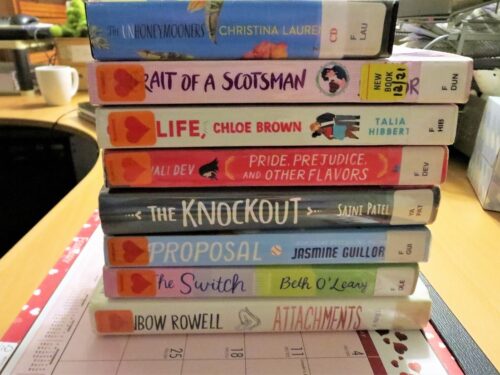
Some of the Books Gotta Go

Buying books makes me feel good, and owning books makes me feel good. Every new book brings the hope of new information to be learned, new worlds to be discovered, new characters to fall in love with, and new authors to stan. Every old book is like an old friend. Books are wonderful that way, and they are hard to resist.

They are also hard to store, though, which was why I started the GLP (Great Library Purge) all those years ago. And it’s why I began to grade the books that I read, so that I’d have a means of determining which books to keep and which ones to donate. The problem is, of course, that over time, even the A-grade books begin to take up too much space. I once again have way more books than I have room.

During the early part of the pandemic, buying books was the only way for us to get new reading material. Livia was particularly in need of new reading material, and I was particularly in need of hope. Between the two of us, I had plenty of justification for buying box after box of new books.

Now the library is back to business as usual, and I have started to borrow books again more regularly. In fact, I’m reading a library book right now. That is good, and it is necessary. There are times when buying books is reasonable, but borrowing is usually better. So I’m going to try to switch back to that mentality. I’m also going to try to give away more books. Though an A-grade book is arguably worth keeping, that doesn’t mean there’s any point to keeping it. I should consider how likely it is that I or my family will read the book in the future. If the odds are low, the book’s gotta go.

Posted in Reading | Tagged | Leave a comment

SITY: Survivors

Many of the plants in my yard are aggressive spreaders, and I often characterize them as battling one another for dominance, especially as new plants arrive and join the fray. But there don’t seem to be any major losers in this battle so far. Most of the existing plants have either held their ground or moved themselves to less contested areas. I wouldn’t have thought plants could move themselves, but they do. The small white violets, for example, have shifted themselves from the back yard to the side yard.

Over time, some of the weedier plants have won me over somewhat. Ground ivy, for example, is aggressive and non-native, but it’s also attractively colored and bee-friendly. And, because ground ivy grew in my parents’ yard, it reminds me of home, especially when it is freshly mown (it has its own distinctive, earthy smell). I realized quickly the futility of trying to eradicate it, and perhaps the inevitability of its presence here helped me to get over any dismay I felt over its invasive tendencies.

Ground ivy is as weedy as they come, but it’s one of the earliest bloomers (picture from mid-April), and its cheerful purple-blue flowers and green-to-purple foliage bring much appreciated color in the spring.

But there are also some plants that I’ve come to like less over time. Dwarf cinquefoil is a native plant, said to be popular with the insects, and it grows in poor soil. It also has cheerful yellow flowers. Those are definite pluses, and I can’t really find anything negative about it online, but I don’t find it to be a good yard plant. Every year it expands its range, butting out some of the other plants, and leaving the soil poorly protected with its low and patchy growth.

Dwarf cinquefoil may be popular with the insects, but I don’t like its low and patchy growth.

One particularly worrisome plant is hairy bittercress, an invasive import. Had I realized what it was when I first saw it, I might have managed to limit its spread, but it’s well established now. Its leaves are so low and its flower stalks so skinny that it blends into the grass, making it nearly invisible and hard to assess quantity-wise, but I would guess that it exists in every square foot of the front yard, and it’s rapidly spreading into the side yard. Every year I pull some of it out, but never enough. One day this spring I pulled a whole grocery-bag’s worth. Some of it was already seeding, and it blasted me as I pulled it (OMG, how those seeds fly!), but most of it was on the cusp, and I got to it just in time. I know it was an exercise in futility, but it made me feel better. Hairy bittercress is said to be edible, so I suppose it would be a good plant to have around during the Apocalypse. That’s about the only nice thing I have to say about it.

Hairy Bittercress (picture from mid-April 2019)
Here is hairy bittercress shown in its absolute best light: growing in a clump near an old stump. It looks nice, right? But, in a lawn, it’s virtually invisible and spreads unnoticed until it’s everywhere. Those things at the top that look sort of like wild rice are its seed capsules (known as “siliques”). Later they will launch the seeds like miniature cannonballs, a dispersal method known as “explosive dehiscence.” It’s really impressive, even if it’s not a good thing.

I am also troubled by the way a few of our inherited garden plants are spreading (more on that to come in a future post). I think that some of them will ultimately need to be removed. Right now I’m working on a landscaping plan for the yard. It’s a complicated task made harder by the fact that I have little gardening experience. I would like to finish the plan this year, after keeping a close eye on how the native plants behave in various parts of the yard, and begin implementing it next year. We have some beautiful native plants that would be even more beautiful if they could be convinced to grow in the right places and the right density. Perhaps it’s just a pipe dream, but it’s a good dream.

For now, I continued to be fascinated by the arrival of new plants, and I enjoy watching them try to make homes for themselves here. However troubled I may be by the aggressiveness of some, it’s heartening to see so many success stories. I don’t keep an inventory, but I think it’s likely that every type of plant that I’ve ever identified in the yard is still growing around here somewhere. They’re all survivors.

Posted in Local Flora and Fauna | Tagged , | 1 Comment