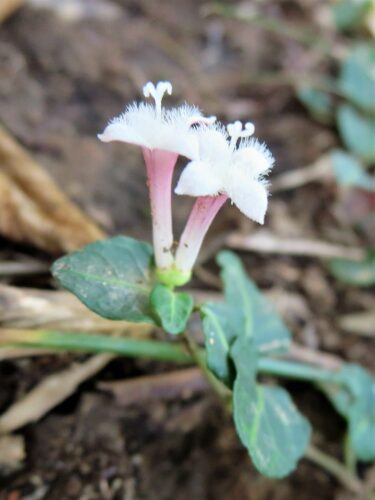
A whole month elapsed between the time I took the first photo of beechdrops (9/26) and the last photo (10/28). If you’d asked me how long it was, I would have said maybe two weeks. I only seem to understand time on the small scale–minutes, hours, and days. I sense the steady tick-tock of minutes, the light of the day brightening and dimming, the temperature rising and falling. On this scale time is knowable. On the larger scale–weeks, months, years, decades–I am lost. It was just summer, and now it is fall. The children were just toddlers, and now they are nearly teenagers. I just started my job, and now I’m a 25-year veteran. It’s confusing. Perhaps this is why I like to focus on small things such as wildflowers. Flowers are to Nature as minutes are to Time.
While researching beechdrops, I found this blog post from the New York Botanical Garden that talks about pyrola, which turns out to have a parasitic evil twin. It says, “American wintergreen (Pyrola americana) is seen most often in its autotrophic variety, a sun-loving plant with amiable green leaves and shy flowers blooming in pinks or creams; the Cherokee would sometimes place the leaves on cuts to aid healing. But on the other side of the coin is a darker variety of wintergreen, chlorophyll-free and boasting red leaves, if any at all. And as a myco-heterotroph, it can only grow when parasitically attached to another organism…; in this case, ‘myco’ refers to its sweet tooth for feeding on underground fungi, the same mycorrhizal fungus that forms a symbiotic relationship with trees…. Pyrola is one of only a few plant groups to produce species in both autotrophic and parasitic varieties, something that pushes the evolutionary envelope as we currently know it.” Is that cool or what?
When I looked up more information about the purple mushrooms that I spotted in the woods recently, my search string brought up articles mentioning that the spotted lanternfly had been found in Rhode Island. It was only one individual insect, but where there is one there are likely more. I refuse to think too much about it, though. I’m already sad enough seeing the damage that the winter and gypsy moths have done and anticipating the damage that the emerald ash borer will do. The spotted lanternfly is just too much for me.
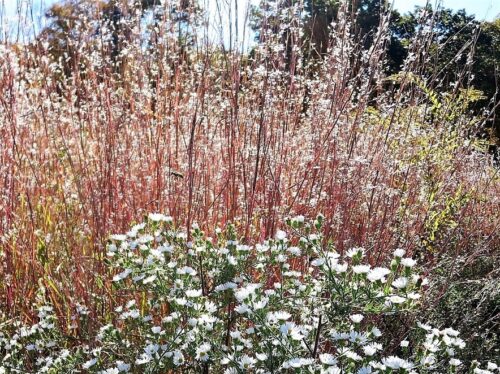
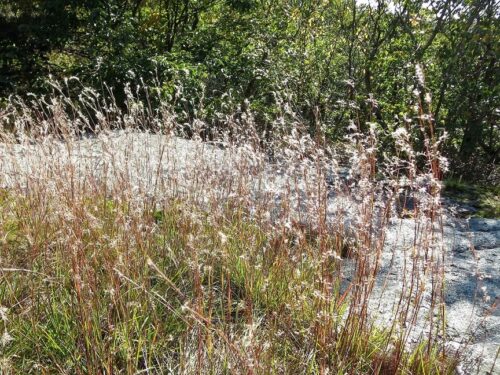
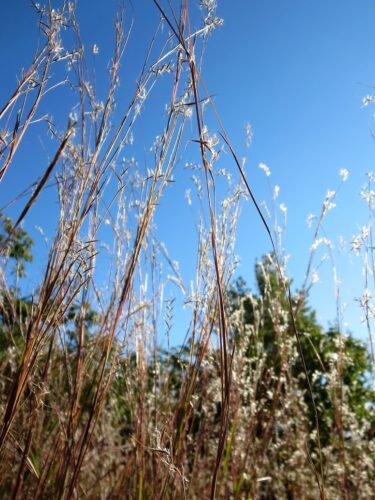
This is a plant that I’ve found at all of the rocky clearings in the woods, as well as the meadowy area near the power-line corridor. I’ve identified it as little bluestem, a native grass. “Little bluestem” seems almost like a misnomer for such a tall, red-toned grass, but during the spring and summer, it’s smaller and bluer. Or so I’m told. Honestly, I never notice it until the fall, when it suddenly reaches up to capture the sun with its coppery stems and feathery seeds. Because it’s so attractive in the fall, little bluestem is often used as an ornamental, and there are many cultivars available. It’s also low-maintenance, drought-resistant, and has a deep root system, making it a good plant for erosion control. Best of all, it’s a source of food and shelter for birds, insects, and other woodland creatures. Little bluestem is an all-around winner.
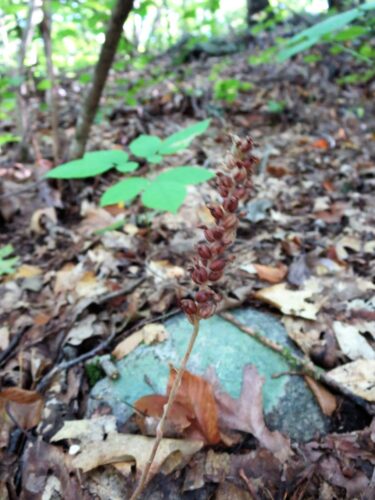
Halloween deserves a creepy plant, and I have just the one.
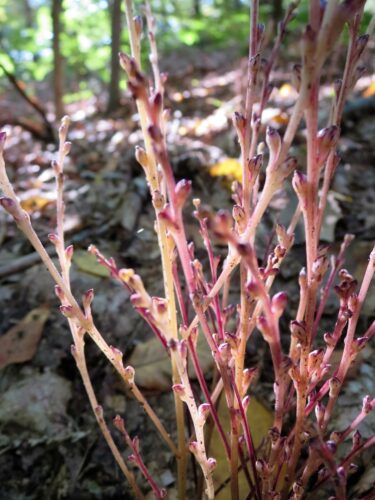
Creepy Plant Budding 9/26/2021
Closeup of the Buds
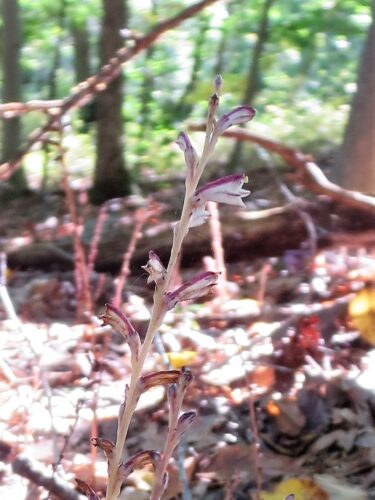
Creepy Plant Flowering 10/6/2021
Closeup of the Flowers
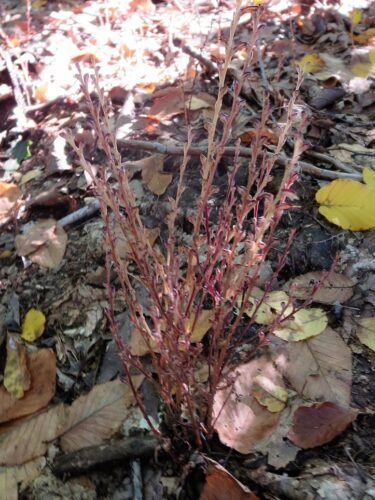
Creepy Plant Seeding in the Company of a Large Fungus 10/28/2021 In the background of this picture you can see the smooth, silvery bark of beech trees, a hint at the identity of this plant.
This plant is called beechdrops. I’m not the only person to think that it looks creepy. As the writer at one wildflower website put it, “From a distance, this plant looks like it is dead, even when it is in bloom, resembling an elongated skeletal hand that has poked up from the ground.” I’m not sure I’d go quite that far, but the plant does look eerie both in the skeletal whiteness of its youth and the gangly brownness of its old age.
But beechdrops doesn’t just look creepy, it is creepy. It’s a parasite. Like a ghostly leech, it survives by sucking energy from its host plant, the American beech. This parasitic relationship is referenced in the flower’s scientific name, Epifagus virginiana (“epifagus” means “upon beech”). The beechdrops plant taps into the tree’s roots using a structure called a haustorium. This doesn’t hurt the host beech, though. According to Wikipedia, beechdrops is actually an indicator of forest health (“the lack of its presence is a sign that forest health is declining”). I would say that forest health is declining here, but not enough to have scared the creepy plant away, and I’ll take that as a win.
What else is interesting to know about beechdrops? Like Indian pipe and pinesap (a.k.a. false beechdrops) this plant has no chlorophyll, which explains its coloring. Like several of the other plants I’ve investigated, including violets, jewelweed, and Venus’s looking glass, beechdrops has both regular and cleistogamous (self-pollinating) flowers. It’s pollinated by winter ants, and its seeds are dispersed by rain.
Beechdrops is a plant that’s easy to overlook, because it tends to blend in with the background. Let it be a reminder to us to stop every now and again along our way and take a closer look at the things around us. We might be surprised at what we find. Today is Halloween, and who knows what other creepy things we might see if we really look…
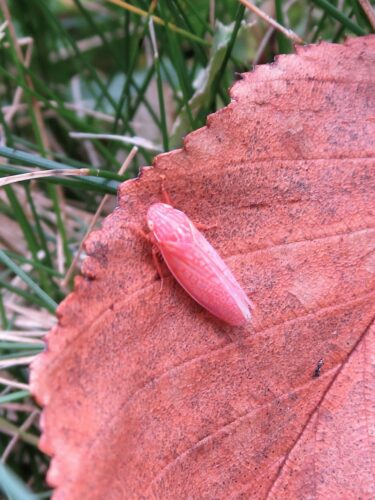
Pink Leafhopper Insect identification is not my bag, but I think there’s a good chance that this pink cutie is Gyponana gladia. It has the right appearance, and I found it at the right time of year (September-November) and in the right kind of place (near hardwood forest). But, right or wrong, the scientific name is a mouthful, so let’s just call this bug a “pink leafhopper.”
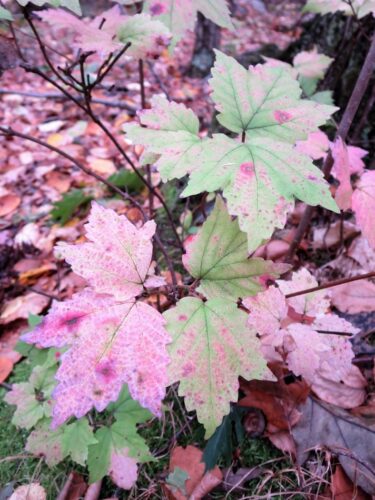
Pink Leaves I love bright fall colors–flaming yellows and rampant reds–but this subdued pink is lovely, too.
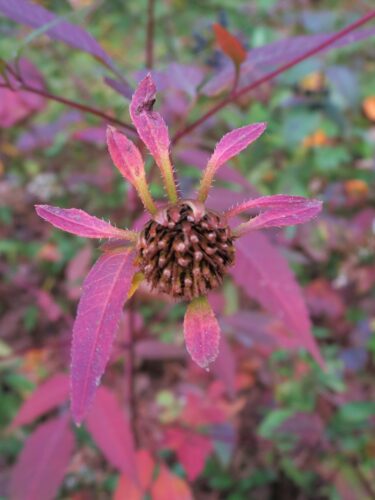
Autumn-Purpled Beggar-Ticks This newcomer to my yard looks much like a plant I spotted along the nature trail back in 2019. Bidens frondosa (devil’s beggar-ticks) seemed like a good guess at that particular plant’s identity, and it seems like an equally good guess for this one.
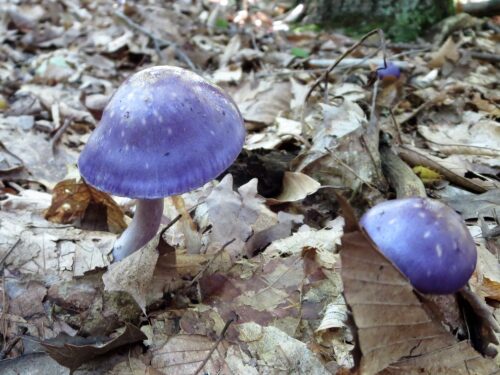
Purple Mushrooms The year 2021 might not have been great for some things, but it has certainly been a good year for fungus. The kids and I went hiking a few weeks ago and there were mushrooms everywhere. Mushroom identification is another thing I have no expertise in, and there are quite a few more purple mushrooms than I would have thought, but my best guess is Cortinarius iodes.
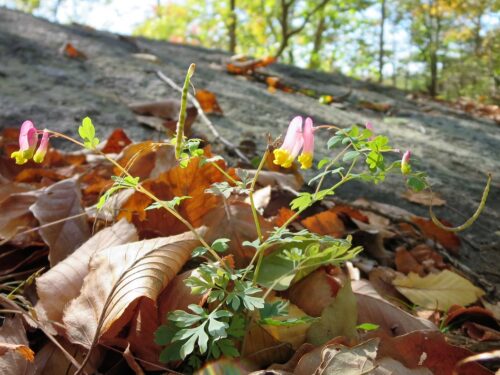
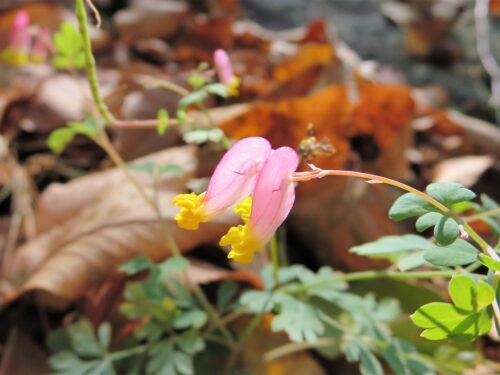
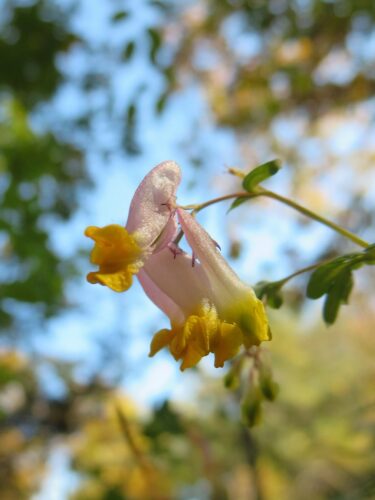
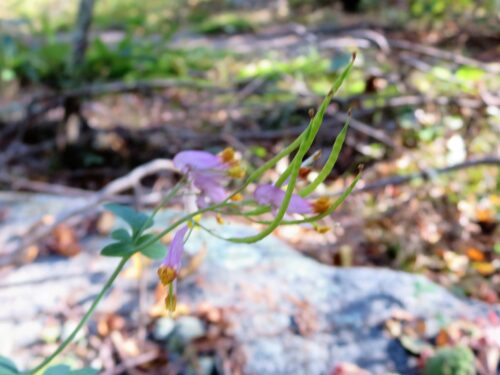
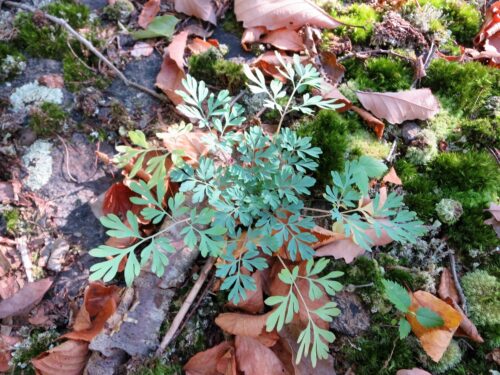
It’s a good thing I was hunting so carefully for interesting things in the woods last week or I might have walked right past this charming wildflower.
Charming Wildflower
Closeup of the Flowers
More Flowers
Look at those long seed pods!
The foliage is eye-catching, like a giant, green snowflake.
Isn’t this plant lovely? My field guide calls it “tall cordyalis,” but many sources refer to it as “rock harlequin,” including this webpage. I like that name better, so rock harlequin it is. My field guide says that rock harlequin’s habitat is rocky clearings, and that’s consistent with the two places that I found it growing (in all but one of the pictures above you can see rock behind or under the plant). I found quite a few of these plants once I starting looking specifically for them. Most weren’t in bloom, perhaps because rock harlequin doesn’t bloom until its second summer. Also, the bloom time is supposed to be April-September, but it’s late October now, so maybe these particular specimens were just outliers. The flowers, though beautiful and brightly-colored, are small, so the leaves are in their own way more of an attention-grabber. But, whichever part of it makes you take a closer look, you’ll be glad that you did.
It’s usually difficult to identify wildflowers when they aren’t in bloom, but sometimes they have such distinctive foliage that you can figure out what they are, even if you’ve never seen their flowers. Such was the case with the round-leaved pyrola that I found growing near my driveway and wrote about earlier this year. The appearance of its leaves (shape, markings, and texture) was enough for me to feel confident in identifying it. When the plant finally bloomed, it looked exactly as expected. If I was wrong about what it was, I was not far wrong. It was definitely a type of pyrola. I had promised that I would post a picture of it in bloom, and here it is.
Round-Leaved Pyrola in Bloom 6/20/2021
Spotted wintergreen is another plant that I identified without seeing its flowers. I have since seen in blooming, at night!
Spotted Wintergreen in Bloom 7/5/2021
Round-leaved pyrola and spotted wintergreen are similar. They enjoy the same growing conditions, and even sometimes grow together.
Spotted Wintergreen and Round-Leaved Pyrola Growing Together 10/6/2021
But there is yet another plant that grows in the same area and that has dark green foliage marked with lighter veins.
Another Plant With Distinctive Leaves 10/6/2021
Browning Flower Stalk 10/6/2021
The foliage and flower stalk are distinctive enough for me to feel safe making a guess about the identity of this plant. I believe that it’s downy rattlesnake plantain. Rattlesnake plantain is not related to the plantains that grow in my yard or to the pyrola and wintergreen. It is actually an orchid. Though common, it’s picky about where it grows, because it needs to be around certain types of fungi. If you’re interested in that, you can read more in this Smithsonian article about the relationship between orchids and fungi.
I hope to see rattlesnake plantain in bloom someday. In order to do so, I’ll have to go into the woods during the hottest, buggiest time of year (July-September), which is something I generally avoid doing. But, I found the rattlesnake plantains growing close to the edges of my property, so I wouldn’t have to trek far into the woods to hunt for the flowers.
I used to feel like my woods were lacking in wildflowers. That idea seems laughable now, as I’m sitting here writing my umpteenth blog post about local flowers. Looking back, I realize that I had several biases. The first was that I wasn’t counting the most common flowers, like goldenrod. Sure, goldenrod is common, but it’s still a wildflower, and it’s not just goldenrod–there are many varieties of goldenrod, each special in its own way. Another bias was that I was disappointed not to see certain flowers that I remembered from childhood, such as bloodroot, trillium, and Dutchman’s breeches. Those plants don’t grow here (as far as I know), but that doesn’t mean that we have any dearth of wildflowers. My third and most obvious bias was my reluctance to hike in the woods during the summer. Summer is the time when many wildflowers bloom, obviously. So I feel foolish for having thought that my woods were lacking, but grateful to have since found some many interesting flowers–orchids, even–growing here in my very own woods.
The job of all the senses is to pick up clues from the outside world in various forms: lightwaves, changes in air pressure, chemical signals. That information is translated into millions of tiny electrical pulses. Your brain reads these electrical pulses, in effect, like a computer reads code. It uses that code to actively construct your reality, fooling you into believing this controlled hallucination is real. Then it uses its senses as fact-checkers, rapidly tweaking what it’s showing you whenever it detects something unexpected.
It’s because of this process that we sometimes “see” things that aren’t actually there. Say it’s dusk and you think you’ve seen a strange, stooping man with a top hat and a cane loitering by a gate, but you soon realise it’s just a tree stump and a bramble. You say to your companion, “I thought I saw a weird guy over there.” You did see that weird guy over there. Your brain thought he was there so it put him there. Then when you approached and new, more accurate, information was detected, it rapidly redrew the scene, and your hallucination was updated.
from The Science of Storytelling by Will Storr
These paragraphs stood out to me as I was reading The Science of Storytelling by Will Storr. They reminded me particularly of a scene in my novel where a character is developing new senses and has to learn to distinguish between things such as light waves and sound waves. The two paragraphs also interested me because, like other people, I sometimes see things that aren’t there. For example, my husband and I used to have a Ghost Cat. We’d see something out of the corner of our eye, and it would assume the shape of a cat, until we turned to look more closely and realized that there was nothing there.
Now that we don’t have real cats, we don’t see the Ghost Cat anymore. This suggests that the brain needs to be primed in some way to see a “phantom.” That is, the brain can easily conjure up the phantom of a man next to a gate or a scurrying cat, because those are reasonable things to see. It’s unlikely to conjure up the image of a squid near a gate, though. But, perhaps it could see a monster if you were scared, or an angel if you wished desperately to see one, or any number of otherworldly images created from your greatest hopes, fears, and expectations.
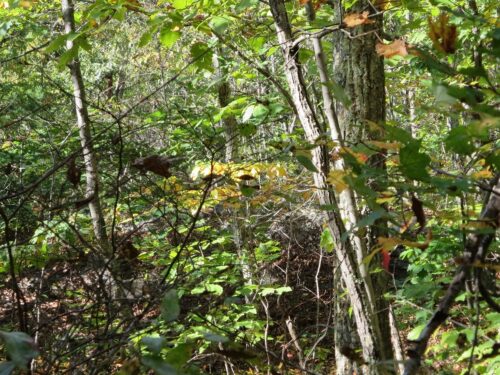
As I was walking in the woods the other day, I saw a phantom. It was not a thing I expected to see in the woods, but it was something that existed in my surface thoughts–a school bus. I took a picture of it.
The Phantom School Bus
In reality it was just a patch of yellow leaves, but for a fraction of a second it was a school bus driving through the woods. Even now, knowing that it’s just leaves, I can still see the vague outlines of the bus. The image is blurred because the bus is moving fast and far away. Look at it go!
The Phantom School Bus was the oddest thing that I saw in the woods that day, odder even than the October blueberries. But, the woods were full of interesting things, and I have many pictures yet to share. More posts to come soon.
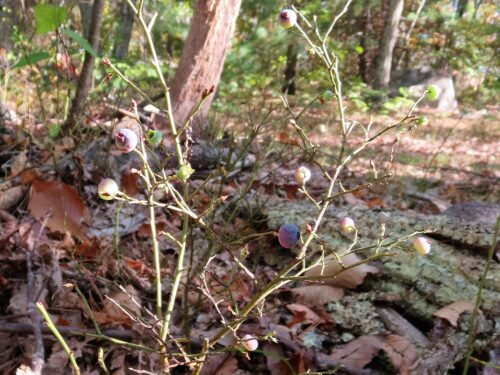
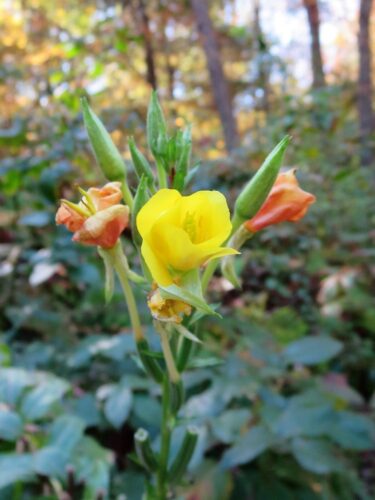
It is fall, and most of the local plants are behaving accordingly, but not all.
Blueberries are a summer fruit, so I don’t expect to find them in October. On Thursday I found several blueberry bushes with fruit on them. It is unusual, but not terribly rare, I guess.
Evening primrose is one of the first wildflowers I ever identified. This plant is supposed to prefer dry, sunny locations and to bloom in the summer, but here it is blooming in a damp, shady area in late October. What a rebel! Evening primrose is a night-bloomer, so that particular flower must have been just opening rather than starting to close. My field guide says that the flowers are lemon-scented. I will have to give this flower a sniff the next time I see it.
We had a large bloom of partridgeberry in the side yard this year. There were enough of those tiny flowers to perfume the air, and they smelled amazing (my husband said that someone ought to make a soap with the scent). That was back in June, so this fall-blooming specimen is well out of step with its kin.
Is there any significance to there being so many plants blooming or fruiting at an odd time? I don’t know. I have often seen common plants, such as dandelions and violets, bloom late in the year. It is my understanding that sometimes plants bloom out of season because there is something wrong with them. It is also possible that the warming environment is stretching out their blooming and fruiting seasons. It seems reasonable that if warmer spring temperatures are affecting plants, then warmer fall temperatures could, too. But it may simply be that some individual plants march to the beat of their own drum. This is a subject of interest, and I hope to learn more about it in the future.
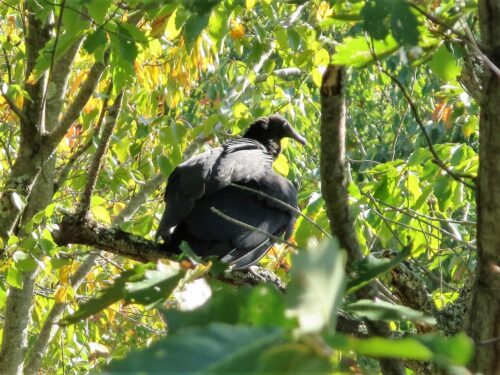
I took a walk in the woods yesterday. Up at the Scenic Overlook, there was a strange sound, raspy, like something being scraped over and over again. I wanted know what it was, so I crept closer, expecting to find human beings working on something, though I couldn’t imagine what. Suddenly several large birds burst out of the brush. One of them perched in a tree for a moment before joining its cronies in the sky. I managed to capture a picture of it.
Big Bird in a Tree
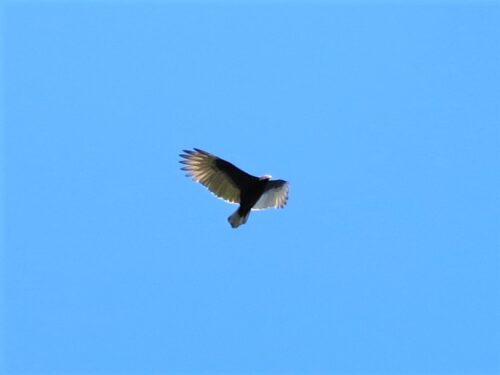
The bird in the photo looks like a vulture, but not a turkey vulture (its head isn’t red), so it must be a black vulture. Both types live in Rhode Island, as I’ve since learned. But, there were four birds total, and I’m pretty sure that one of them was a turkey vulture.
This one looks like a turkey vulture, because the white goes all the way down its wings.
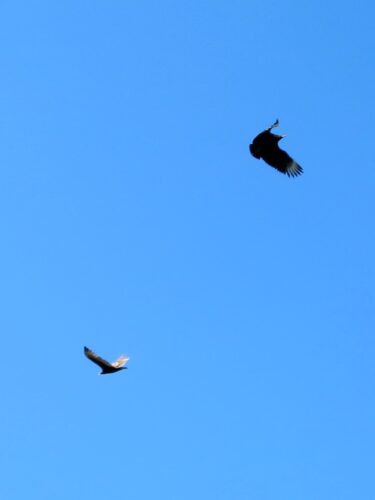
Here are two of the birds flying in the same patch of sky. The one on the left is hard to see clearly, but it’s probably the turkey vulture. The one on the right, which has a patch of white near the end of its wing, is probably a black vulture.
Apparently the two types are often found together. Black vultures, which depend on sight for finding food, sometimes follow turkey vultures around, because turkey vultures can locate food from miles away, just by smell. Black vultures are moochers.
I was curious about what the vultures had been up to before I startled them. Presumably they had found themselves something deliciously dead to nosh on. But they were circling overhead, waiting for me to leave, their shadows slicing across mine. I wasn’t sure I had the stomach for viewing half-eaten dead things anyway, so I decided not to investigate. However, I found many other interesting things in the woods that day, including a new wildflower. More posts to come soon.
In previous installments of How I Met My Book, I talked about hand-me-down books and unexpected loaners. For this installment I want to tell you about my copy of The Waste Land and Other Poems by T.S. Eliot. I’ve bought so many books lately that you might easily assume this slender volume was one of them, but no. This one I “borrowed” from my parents’ library a long, long time ago, and it has since taken up permanent residence on my bookshelf.
You might wonder why I’ve kept it all these years, especially since until recently I hadn’t read any part of it. The book is certainly no looker. It’s a dismal gray and worn around the edges, not to mention grubby.
I’m tempted to take a swipe at those stains on the cover. I think some of them might be removable, but I’m not going to touch the coffee ring. The ring is like an Official Seal of Authenticity certifying the book’s age and previous usage. The book survived college life in the 1960s, and it sure looks it. I like that about it.
I’m being self-contradictory, I know. Usually I prefer clean books, as most people tend to do. But I also love a book that has something to say about its own history. This book has been in the family for a long time, so its “germs” are family germs. Its grubbiness is familiar and endearing.
Back in April of this year I finally tried to read the book. Afterward I wrote, “Eliot’s work represents both the best and the worst of what poetry has to offer. Some of it is so perfect that it will stop you in your tracks. And some of it, if you’ll pardon my French, is obfuscatory bullshit.” Had it not been for the book’s provenance, I probably wouldn’t have kept it, but I did and probably will forever. Maybe I’ll even try again to read it during some future April, but a less “cruel” one, I hope.