A little advice from M. Poirot:
One must not permit oneself to be obsessed by one idea.
from The Big Four
A little advice from M. Poirot:
One must not permit oneself to be obsessed by one idea.
from The Big Four
I went for a walk in the woods yesterday. As usual, I brought my camera, but it was unusually hard to find a visually attractive subject. The landscape looked much the same as it had in the fall. The ground was still brown with fallen leaves. The trees were still naked and spindly. The rocks were still rough, unforgiving lumps of gray. Gray, gray, gray. Even the sky was gray. Only lichens, mosses, and pine trees provided some relief from the neutral colors.
But why am I going on and on when I have pictures to show you?
First, imagine Verizon’s “Can you hear me now?” guy walking through this scraggly landscape.
It may look desolate and far from civilization, but if you take just a few steps forward, this will be your view:
Ironically, when I am out and about in the woods, communing with Nature, I have excellent cell-phone reception, presumably thanks to those towers on the horizon. At home, behind the big, rocky hill on which I stood to take this picture, I’m lucky if I get a single bar.
Those birds in the sky are turkey vultures—ugly up-close but beautiful in the sky. Did you know that the turkey vulture can find food by its scent?
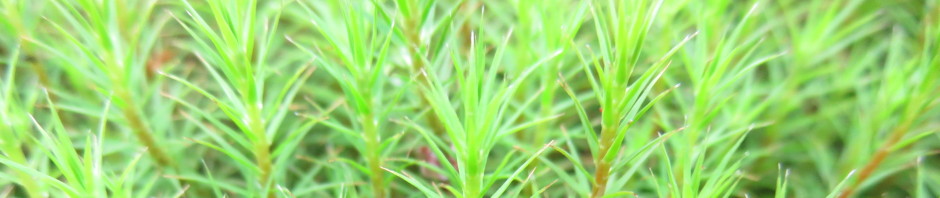
Back on the ground, there are so many types of mosses and lichens. There are pillowy green mosses, like this.
And there are many weird, silvery gray to pale green varieties of lichen, some of which spread in creepy patches on trees, or like a rash on the rocks, and some in rounded masses on the soil.
While there is green to be found, brown is the dominant color on the ground. The hungry eye searches for anything interesting among the papery leaves and brittle grass. Any distinct shape is like a feast after famine.
There are trees that hold on to their shriveled leaves through the winter. Some of the leaves curl up like seashells. When the wind whirls by, the leaves shake and whisper in a way that can send shivers up your spine if you’re all alone in the woods.
As I make my way back down the hill, icy snow flurries fall hard enough to pitter-patter on the ground. I try to capture a snowflake on my glove, but it melts away even as I aim the camera.
The train pulled into Bath at a time that was morning for the British, but well past bedtime for us. The first order of business was to acquire some English currency. This we accomplished the old-fashioned way: an ATM machine. We had read this was the cheapest and easiest way to do it, and it works great, at least if you know your PIN number. English ATM keys do not have letters on them. I knew my PIN only as a word, not a number. I had to stand aside to let other people use the machine while I puzzled out the PIN (“Don’t mind me. I’m just a stupid tourist!”).
Next we did something very frugal but not exactly fun. We needed to get from the train station to the hotel, which was at the top of the hill. Rather than pay for a cab, we trudged up the hill, gamely pulling our luggage behind us. When we got to the hotel room, I could have slept for the rest of the day, but Faithful Reader would only let me nap for an hour. I don’t know if staying awake for most of the day helped me adjust to local time or if it just made me crankier. I was definitely cranky.
We stayed at a place called Brocks Guest House, a beautiful Georgian house, well kept and attractively decorated, and conveniently located between two of Bath’s most notable architectural features, the Royal Crescent and the Circus.
There we learned many more things about travel in England. For one thing, parking is tight. Looking out the back window, we could see a parking lot and every space (every single area in which you could have fit a car) was filled. Only the car at the very end could leave without having to wait for other cars to be moved.
Another thing that’s tight is bathroom space. Rooms that have bathrooms en suite are almost inevitably retrofitted. Consequently, the showers are tiny, barely wide enough to wash yourself without banging your elbows against the cold shower walls. Strangely, most of the bathrooms at the hotels in which we stayed had wall-to-wall carpeting. With the threat of nasty plumbing mishaps always looming, who would risk carpeting in the bathroom? The British, I guess. It was odd, but very comfortable for the feet, so I’m not complaining.
But the British are very generous with refreshments. I think every room we stayed at had the makings for tea and coffee, and all but one had little packages of cookies. We snacked on the cookies before leaving for our explorations.
It was probably mid-afternoon when we left the hotel. We scouted out the lay of the land and wandered rather desperately until the restaurants finally opened for dinner. Downtown Bath has suffered the intrusion of chain stores but it nevertheless has a charm that you don’t often find in modern cities. The abbey, the Roman Baths, the cobbled streets—they all add to the feeling of living for a moment in the distant past.
Bath also did not lack for restaurants serving ethnic cuisines. I looked forward to sampling some new flavors. We ate dinner at a Thai restaurant. Its only real virtue, as it turned out, was that it opened earlier than most of the other restaurants in town. I used my credit card to pay for that dinner, and I remember fretting over whether or not to leave a tip. There was a place for it on the receipt, but I had thought that the British didn’t subscribe to tipping, and that it was really more of an American thing. I couldn’t remember for sure, so I left one, just in case. I probably got ripped off.
I also didn’t know until I returned to the States that every credit card transaction in England was costing me a fee. When I got home and saw my statement, I was furious. It added up to something like $40.00, so I called up my credit card company and complained. Miracle of miracles, they took the fees off as a “one-time courtesy,” proving yet again that it never hurts to ask. Sometimes it’s good to be ignorant. Had I known about the fees while I was using the credit card, I never would have complained about them.
Having filled ourselves with food, we wandered a bit more and then went back to the hotel room to sleep (finally!).
This site is experiencing some technical difficulties. If a page won’t load, keep trying. It usually will after a couple of tries. There’s nothing I can do to fix the problem for the moment, so we’ll all just have to bear with it until there’s a software update. Sorry.
Dear Livia,
It’s strange that you ended up with the name Livia. There were so many things counting against it.
To start, the most important criterion I used when hunting for a girl’s name was that it not end with the letter A or its sound. And what letter does Livia end with? A, of course.
But as I always say, you have to know why a rule exists in order to break it properly. I made the rule against the ending A in order to avoid singsong, a possibility because your surname also ends with A. Can you imagine being named Sarah or Mariah? Yuck! It’s not just the ending sound that causes the problem with those names, though. It’s also the R and how the stresses fall on the syllables. Sarah, Mariah, and your last name each have an R and end with a stressed syllable followed by an unstressed one. Livia does not, so no singsong.
Other family members had their own ideas about how you should be named. Your grammie suggested Melody and Jocelyn. Your vovó and vovô pushed for Florentine. Your father’s cousin Joe and his wife Jessica offered Romana (jokingly, I hope). Though we gave Melody some consideration, neither it nor the others seemed quite right.
The name Livia was still a contender, so next we tried to think of other people who had the name. We could only think of one: Livia Drusilla, wife of Caesar Augustus. Your father and I knew her from the BBC miniseries I, Claudius. That Livia is decidedly bad. She poisons everyone who gets in her way. Her evilness ought to have turned us off to the name straightaway.
But Livia Drusilla is an admirable character in some ways. She is strong, capable, poised. We wish those attributes for you. Just don’t get all power hungry and mass-murdery, OK?
The last obstacle for the name Livia was its similarity to Olivia. I don’t like the name Olivia. It’s extremely popular right now. I wouldn’t want to give you a popular name. It’s harder to feel a sense of individuality when your name is the same as everyone else’s. Plus, when your hear your name, it’s nice if you can assume that you’re the one being called. By choosing Livia over Olivia, I spared you some of that, but I set you up for a lifetime of having to explain over and over again that there’s no O in your name. Sorry about that, O daughter.
“I’ve had a hatred of that letter ever since the night my mother became wedged in a porthole. We couldn’t pull her in and so we had to push her out….I speak O-words myself, so I can spit them out.”
from The Wonderful O by James Thurber
At last, we were ready to leave the hospital and we needed to make the decision. We had not found a name that we liked better, so Livia you became.
Lovely Livia.
Love,
Mom
P.S. As for your middle name, I liked it so much that I would have given it as a first name if I could have found a good middle name to go with it. If you ever get sick of your first name, consider using your middle instead. That’s what your grammie does; she hates her real name, but don’t tell her I told you.
I love science, and I love to read science articles in the news. There are so many cool discoveries going on. The weird thing is, though, that no one seems to care. Amazing science stories are reported all the time, but they don’t have the mass appeal of other items, like Charlie Sheen’s public meltdown, and so they seem to go largely unnoticed by the public. It’s a shame.
Maybe I can do a tiny bit to help spread the good news by sharing science articles that I find interesting. My favorite story from last year was this one. Long story short: scientists have discovered chemicals in the brains of cockroaches that can kill MRSA. It’s possible that this discovery could lead to a whole new class of antibiotics.
Is that awesome or what? From the lowliest creature on earth we might find a way to save human lives.
“There are more things in heaven and earth, Horatio,
Than are dreamt of in your philosophy.” (Hamlet, Act 1, Scene V)
Dear Marshall,
When you were very young, we kept all of your books on a shelf in your room. We wanted them to be close at hand for spontaneous reading. After you learned to stand, you were able to reach them yourself and, as we had hoped, you started bringing the books to us to be read.
Then you developed a fondness for tearing paper pages and dust jackets. “Fine,” we said. “We’ll just let him keep the board books for now. Those are durable.”
Not durable enough. You bent pages, broke spines, even tore some of the books in half. We doggedly stuck to the idea that your books should be available to you. We didn’t want you to think of them as being off limits in any way. After all, a few destroyed books are a small price to pay for a lifelong love of reading.
But then came the day when you learned to separate the pictures from the boards. Suddenly Dr. Seuss’s ABC was missing pictures for A and B. No big deal. Twenty-four letters are still better than none, right? Except that we found A and B in your mouth, where you had chewed them into gross, wet wads. We had wanted you to be a bookworm, but not in the literal sense! Did we read The Very Hungry Caterpillar to you too many times?
So we had to take the rest of your books away. Sorry. You can have them back when you learn the difference between food and food for thought.
Love,
Mom
It’s Girl Scout cookie season. Yum! I wish I had a Poirot quote relating to Girl Scouts. Oh, well. Boy Scouts will have to do. Poirot says,
If one is prepared in advance all is simple—the motto of the Boy Scout, is it not? And a very fine one.
from The Big Four
A wireless weather station is one of those gadgets that people typically buy for each other at Christmas but which no one really needs or wants. We’re an exception, though. We bought one for ourselves and we like it. We’ve even come to depend on it. For example, how else would we know when a summer night was cool enough to run the fan instead of the AC? Stepping outside would give us a general idea of the temperature, but just because it feels cool doesn’t mean that it’s actually cold enough to beat the heat that builds up on the second floor of our house. Thanks to the weather station, we know for sure.
A few months ago, the weather station’s batteries started running low. We knew that as soon as they died or were removed, all of the information contained in the weather station’s memory would be gone. We were unhappy about that, because our “extremes” were about to disappear. They were…
Low: -2.7°
High: 101.2°
Wow! In the time between moving into the house and the batteries’ death, we experienced a range of over 100 degrees of temperature.
But why did we care? I can’t speak for my husband, but for me the extremes showed that our house had protected us from freezing cold and broiling heat. Silly as it sounds, it gave me a feeling of safety to know that. I didn’t need to fear any temperature between those two extremes. I had already experienced it and survived, and the extremes displayed on the weather station were the proof.
Luckily, there are all kinds of memory. This blog is a form of memory and now I’m storing those extremes here in this post. Meanwhile, our weather station is still collecting data. With the old extremes recorded here, I can look forward to new ones. How much temperature variation will we experience this year? Our low is already almost unimaginably low (-16.9°). Will summer bring us temps above 101.2°? We’ll see!
© 2007-2026 Author of Blue-Footed Musings All Rights Reserved