Rhapsody in Blue

The asters were amazing this year. I found not only the usual white asters, but also pink, purple, and blue. I found them in the woods, and I found them in the meadows. One day, there were so many asters blooming, and so many bees on them, that the loud and persistent buzzing made me feel anxious, though also delighted that there was so much insect activity.

I took a lot of pictures. Very few came out well, so I’m not sure I can do the Asters of 2019 justice, but I’ll try. I’ll start with the wowiest: the blue asters.

Mass of Blue Asters
I found these beautiful asters growing near one end of the path that runs along the power lines. Usually I don’t like to walk near power lines, because the noise grates on my nerves. These lines don’t hum, though, so I was able to mostly ignore them. I found so many new types of flowers growing there in the late summer that I want to go back in the spring to see what blooms then.
Cluster of Blue Asters
White, pink, and yellow flowers have always seemed to be more common than blue ones. Perhaps that’s why I fell so deeply in love with these rare-seeming asters. I may have to bring some of their seeds home with me next time. I need more blue asters in my life.
Single Blue Aster
While researching some of the other plants that I found along the path, I came across this post about power line corridors. The power lines had seemed like a major downside to this particular path. I hadn’t considered that their very existence was the reason that the path was there and the reason that the land was open to so many types of insects and plants. I like this picture as an example of the variety that I found there. It has so many different shades of green, different shapes, and different textures. Diversity is a wonderful thing.
Posted in Local Flora and Fauna, Out and about | Tagged , , , , , | 2 Comments

Finally, Furniture

On Friday our new furniture finally arrived. My and my husband’s new bedroom set looks, I can’t help but to keep saying, POSH. It is dark in color, strongly defined against the light gray walls, and the overall effect is soothing, not cold as I worried it would be. The ridiculously expensive matching mirror that we bought on a whim turned out to be an excellent idea. The artwork that I chose for the room contributes a little dreaminess to the mix. The rug and chest for the foot of the bed are en route. Before we can move back into the room officially, the furniture must be properly leveled and the window treatments purchased and installed, but at least we are seeing the light at the end of the tunnel.

Livia’s furniture, being of a warm, almost cherry tone, looks pretty in her newly painted pink room. We joked that she chose pink to keep her brother out of the room, pink being an anathema to him, but she chose it because it’s her favorite color. It has not actually kept Marshall out of her room. In fact, they seem to miss each other a little bit now that they’re separated, and Marshall was heard knocking on her door yesterday, saying, “Do you want to play the game where you have to find the stuffed animal while looking through the gem?” (I love the weird games kids come up with). Livia’s curtains and rug are en route, and her closet isn’t ready yet, but she moved in the second she got home from school on Friday and has nearly worn out the door lock since she discovered that she can shut everybody out of her space now.

I spent much of my weekend shopping for other necessary items, but I’m not done yet. We still need curtains and curtain rods. There’s also a lot of laundry to do, and cleaning and organizing. The rest of the house is a gigantic mess, because that’s where we put all our stuff to make room for the furniture. Now we have to sort through our belongings and decide what is worth keeping. We want to adopt a clutter-free lifestyle. It’s not going to be easy, but we’re going to give it our best shot. Like they say, begin as you mean to go on.

Posted in Uncategorized | 2 Comments

The Universe Is Laughing

When my alarm went off for the third time this morning, I groggily got out of bed to turn it off. I could hardly believe I’d already snoozed the alarm twice. The Universe was surely in the mood for an inside joke, because the song playing on the clock radio was “Head Over Heels” by Tears for Fears, and the song was on its very last two words: “Time flies.”

Posted in Uncategorized | 1 Comment

Joe Pye Weed

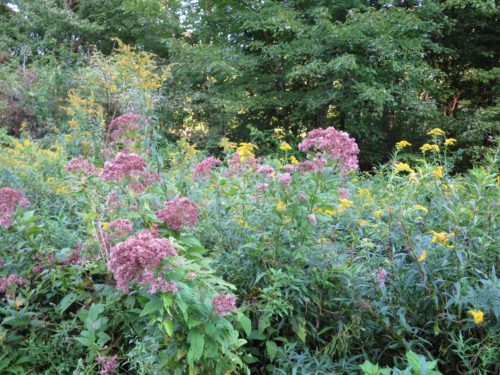
Joe Pye Weed in a Field With Goldenrod
(9/12)
When I first saw Joe Pye weed this year, I initially confused it with milkweed, because the flowers are a similar color. It’s a tall plant, as milkweed is, and it grows in the same places. Otherwise, the two plants aren’t that similar. I will not make that mistake again.
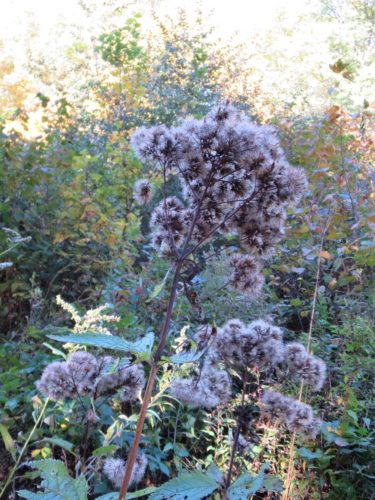
Joe Pye Weed Gone to Seed
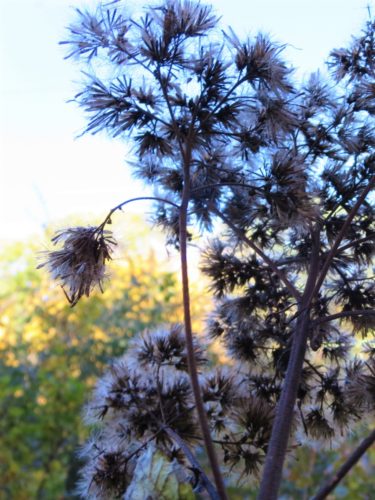
The seeds of Joe Pye weed bring a hint of chilliness to the autumn landscape.
Joe Pye “Snow”
(10/18)

Joe Pye weed is a popular plant among gardeners. When I did an Internet search on it, most of the hits were for gardening, rather than wildflower, websites. Among its positive attributes are that it’s pretty, unusually tall, attractive to pollinators, late-blooming, and easy to grow.

The derivation of the plant’s common name, according to some, is that there was a Native American sachem, born in the 1700s, who used the plant medicinally. His Christian name was said to be Joseph Pye. However, Merriam-Webster’s website lists the derivation as “unknown,” which is a red flag. A little more digging led me to the Phipps blog (Phipps Conservatory and Botanical Gardens in Pittsburgh), which gives a good sum-up of the story but also refers to it as a “legend.” I think that’s as close as we’re going to get to the truth about the name of this plant.

Posted in Interesting words, Local Flora and Fauna, Out and about | Tagged , , , , | 1 Comment

Continuing the Catalog: Part 3

Bittersweet
Bittersweet is so perfectly colored for the season, though poisonous and probably invasive. Well, nobody’s perfect. There are, apparently, two types of bittersweet. One is native (American) and the other is not (an Asian import). Odds are that this is the nonnative, invasive none.
White Campion
This is a familiar flower, even if I never knew what to call it before now. White campion used to grow near one of the soccer fields in my hometown. Sometimes, if I wasn’t playing in the game, I would pick the flower and tear apart the “distinctive inflated calyx” (as Wikipedia refers to it). It was a way to pass the time. There doesn’t seem to be too much else to say about the plant, though this website about Virginia wildflowers has a little more information (plus the site is full of pretty flower pictures and worth visiting just to ooh-and-ah a bit).
White Snakeroot
Here is another member of the aster family (surprise, surprise). This stuff is said to be very toxic. If milk producing animals eat it, the toxins get into the milk, with potentially deadly consequences. One thing that can eat this plant is leaf miner (mentioned at this website), and you can see that one of the leaves in this picture has been damaged, presumably by the same type of insect.
Best Guess: Canada Hawkweed
There are more dandelionish types of flowers than I’d ever realized before, and it can be difficult to tell them apart. My field guide nearly convinced me that this one was cat’s ear, but only because it didn’t include hawkweed. How could a guide about the CT-MA-RI area not included hawkweed? It’s a common plant, one I’ve seen before, just usually with more flowers per stem.
Posted in Local Flora and Fauna, Out and about | Tagged , , , | 1 Comment

Animal Parade

Most of my nature posts have been about plants. There haven’t been many specifically about animals. The reason for that is simple: plants stay still, and animals don’t, so most of my pictures are of plants. But I still manage to capture the occasional insect or critter in a picture. Some I have already included in posts about flowers, such as this one. The stinging insects are usually the easiest to photograph, because they’re not afraid of me (However, one chased me on Saturday, proving that I am afraid of them. I have no idea why it wanted to land on me so badly. I hadn’t done anything to aggravate it!). Snails don’t run away. Deer sometimes freeze. Most other animals, from the tiny to the large, typically run, jump, or fly away from me as fast as possible and before I can get them in focus. It’s incredibly frustrating.

So I don’t have a lot of pictures of animals, and what pictures I do have are not of the best quality. But I will post them anyway, because animals are important, too. After all, something has to eat the plants ๐Ÿ˜‰

This frog was in my yard. I wouldn’t have noticed him, but I startled him when I walked too close. He jumped against my leg, startling me!
Flying grasshoppers won’t give me the time of day. I barely caught this one in a picture. He was gone before I could get a better shot. On Saturday, I disturbed a grasshopper with every step. Zing, zing, zing. Grasshoppers flying every which way, not a single one pausing for a picture.
Woodpecker

These guys are really loud, and I think they do it on purpose, just to get attention. The moment they know you’re watching, they climb as high as they can go so that your picture will be low-resolution. It’s just the way they are.
This yellow guy led me on quite the merry chase. This was the best shot he let me have.
Hornety Insect
Red-Footed Creeper

The rarest of creatures, the red-footed creeper can only be found occasionally in the woods, but it does pause long enough to be photographed.
Posted in Out and about | Leave a comment

Milkweed

Milkweed grows in the meadows along the path where I often walk. I didn’t get any pictures of the flowers this year, so I offer you this post from 2008 (it contains a picture of milkweed flowers, plus a picture of one of the insect species that depends on it). But I did get some other milkweed pictures this year, and here they are.

Milkweed Leaves, Hangouts for Snails
Milkweed Is a Big Plant, Peculiarly Podded
(9/15)
A Trio of Peculiar Pods
Peculiar Pods Popping
(10/18)
Popping Pods Are Pretty
With Asters, Against the Autumn Sky


Posted in Local Flora and Fauna, Out and about | Tagged , , , , , | 1 Comment

Problems and Solutions

Plant identification is a lot trickier than I thought it would be. I have been running into a lot of problems. But I’ve also been thinking about potential solutions.

Problem: Identifying from a picture doesn’t always work well, because the picture never shows all parts of the plant, and sometimes the missing parts are the ones you need for an accurate identification. Details that ought to be visible, such as hairs on a leaf, don’t always come through in a picture. Some plants are more easily identified by smell (“spicy,” “minty,” etc.) or touch (“soft,” “sticky,” etc.), which a picture can’t convey. Also, sometimes the photographed plants aren’t good representative specimens.

Solution: Try to remember to take shots from multiple angles and always, at least, include the leaves. Take pictures of several specimens. Also, try to remember where they were located so you can go back later to see how the plant has changed or to check on a detail. You’re too lazy to keep a field journal, but your memory ought to be up to the task.

Problem: There are too many species! Broad identifications are often fairly easy. But there are so many species to consider, and often hybrids, too. Telling them apart is difficult, sometimes impossible for an amateur.

Solution: Keep your personal goals in mind. Only get as specific as necessary to meet those goals. You’re not going to eat (usually) or market the plants, and you’re not trying to write a textbook. Just try to figure out roughly what it is and whether or not it’s poisonous.

Problem: I don’t know the botanical lingo, and I don’t want to learn it. I’m a word nerd and usually I like knowing words, but honestly, most scientific jargon bores me.

Solution: Learn the most common terms, enough not to sound like an idiot, but continue to ignore the rest. You have too many things to do. You don’t have time to become a botanical expert, and no one expects you to.

Problem: The field guides and websites, however good they may be, have some major oversights. The Wildflowers of Massachusetts, Connecticut, and Rhode Island that I borrowed from the library doesn’t include any hawkweeds. The CT Botanical Society’s website lists five hawkweeds, but not yellow woodsorrel. My National Audubon Society Field Guide to Wildflowers: Eastern Region has three hawkweeds and yellow woodsorrel, but it left me high-and-dry when I was trying to identify mild water-pepper.

Solution: Don’t rely on any one source exclusively.

Posted in Uncategorized | Leave a comment

While It Lasts

I learned a lot about plants as a child. I lived in a quiet suburb, down the road from a farm, and not far from the woods. My parents were both interested in nature, particularly in plants. They kept several gardens: typical landscape plants in the front, showy flowers and herbs along the sunny side, ferns and wildflowers along the shady side, and vegetables in the back yard. My mother would take me on trips to gather things such as bittersweet, cattails, and pussy willows to use as seasonal decorations for the house. My father took my brother and me hiking often.

They taught me to identify many plants. In the woods were skunk cabbage, trillium, bloodroot, Dutchman’s-breeches, Indian pipe, and jewelweed. We were always on the lookout for lady’s-slippers. Wild irises grew behind the soccer fields and bluets along the way to school. In the yard grew violets, white and red clovers, yellow woodsorrel, and pokeweed. Along the back fence, there were wild roses, the same kind that grow near the library here. My mother hated them, because they were invasive and prickly, but I always loved the way they smelled, even though they’d tear at me with their thorns if I wasn’t careful. We once found a litter of kittens sheltering beneath them. The kittens were sick, their eyes infected. I still remember how sad I was when my mother wouldn’t let us keep them. She said they were too sick to survive.

We had several types of maple trees in the yard. One of them was a sugar maple, and my parents decided to tap it one year. They boiled the sap (and boiled, and boiled), until the house became a syrup-scented sauna. This produced just enough syrup for each of us to have a taste on our pancakes that day. So much work for so little payoff. But they took us every year to a genuine “sugar shack,” where we always bought a little jug of syrup, so every year we got to enjoy real maple syrup until the jug ran dry.

I loved the nature magazines, such as Ranger Rick, that we had at school. When one of them included a recipe for violet syrup, I convinced my parents that we should try it. Thankfully, it required a lot less boiling than the maple syrup did. We learned that violet syrup has a strange taste, a little like strawberry, but definitely its own flavor. It’s worth making if only for the sake of watching the syrup change color from a greenish-blue to a bright, jewel-toned pink when you add the requisite acid (e.g., lemon juice).

On vacation at Keuka Lake in upstate New York, there were Queen Anne’s lace, chicory, sweet pea, butter-and-eggs, daisies, and black-eyed Susan. Our vacation usually coincided with blueberry season, so we would devote one day of vacation hiking up alongside the glen, empty coffee cans in hand, to forage for wild blueberries which my father would use to make the most delicious blueberry pancakes.

As children of the neighborhood, we absorbed the children’s lore of foraging, things our parents did not teach us and sometimes didn’t even know about. Every year we sampled the nectars of the red clover and the honeysuckle. The pears in my best friend’s back yard were tempting, but we couldn’t eat them (too much competition from wasps), but we did eat the occasional wild grape from the vines that grew behind her garage. We knew where the raspberries grew, and we felt free to raid our neighbors’ properties for them. When the large mulberry tree at the end of the street was in season, we gorged ourselves on the juicy fruit. My mother didn’t know they were edible, and once, when I came home with my hands and clothes stained purple, she freaked out a bit, worried that I might have eaten something poisonous.

We knew not to eat the catalpa pods that grew at the other end of the street, but I bet I could still recognize the smell of them, because of course we played with them, as we did with pine cones, acorns, and maple seeds. Buttercups always proved how much we liked butter. Behind the school playground there was an impassable thicket of what the other kids called “poison sumac.” I never put the “poison” part to the test, because we trusted each other implicitly, and I still steer clear of anything that looks like it.

And if all of that weren’t enough, my parents also had copies of several books by Euell Gibbons. Gibbons was famous in his day among the back-to-nature types. My parents had an interest in learning more about foraging, and they enjoyed the books, though my father always said that Gibbons had died from stomach cancer and that it was probably from eating all those weird plants (which, as it turns out, is probably not true; the Wikipedia article says he died from an aortic aneurysm). I even occasionally dipped into the books, but I have to admit, the “stomach cancer thing” stuck with me and made me a little leery of foraging for anything other than the most common types of fruit.

All of this I learned as a child. It was more than most kids knew then, and a lot more than most kids are learning now. Though I have been steadily identifying local plants for years, still I probably can’t name half of what I see on my walks. And I guess the point of this post, aside from indulging in nostalgia for my somewhat idyllic childhood, is that we live in a big, amazing, and poorly understood world. Someday soon, we might all feel really sorry for our ignorance of how nature works, when it finally gives up and stops working. I keep voting for better environmental policies, of course, but the last three years have made me less than optimistic about the future. That makes me sad, but at least I can try to better understand our big, amazing world while it lasts.
Posted in Uncategorized | 2 Comments

Color, Light, and Seeds

On my walk yesterday I took 500 pictures. That has to be a record. I deleted about half of them when I got home, but that still leaves a lot of pictures to look through. It’s going to take a long time to decide what to do with them all.

So I’ll start with the easiest. Yesterday was the perfect fall day: sunny, a little chilly, colorful. What I really wanted to do was capture some of its light and color, and I did. Here it is.

Autumn Color and Light

I also wanted to catch up with my flowers, see how they had changed since the last time I was there. I hardly recognized some of them. Then there was this thing:

Whoa! Which one of my flowers did this weird thing come from? I guessed that it had to be an aster, though it was totally different from the other aster seeds.
Here is a picture from farther down the path. This is the same type of plant. The flowers just aren’t as far along in their transformation into seed.
But this one is. It has that same scary look.

While looking more closely at these photos, I noticed something. The seeds are serrated, and when I focused on the individual seeds, suddenly I realized that their shape was familiar. The seeds have “horns.” It’s been many, many years, but I have seen seeds like these before. Attached to my clothing. These are beggar-ticks!

As to which type of flower these seeds came from, that’s a little hard to say (for me, a non-botanist). But, I’m guessing devil’s beggar-ticks (bidens frondosa). Looking at pictures of devil’s beggar-tick flowers online, it looks similar. I think I’ve seen it in bloom before, but its flowers seemed unremarkable, so I paid it no mind. I might have even thought it was an aster whose petals had fallen off. Devil’s beggar-ticks is not in my field guide, but online sources assure me that it does grow in Rhode Island. The only other likely candidate I found was shepherd’s needle, which has white flowers that I could have mistaken for asters (they’re all in the same family–like I said in a previous post, the aster family is The Thing this time of year). But none of my aster pictures are a match for it, and it just doesn’t look right to me. Devil’s beggar-ticks does, so that’s what I’m calling it, at least for now.

I am disappointed that I don’t have pictures of the flowers from earlier in the year. I’ll have to wait a whole year for another chance. But, in the meantime, here is a wonderful site with amazing close-up pictures of beggar-ticks.

Posted in Local Flora and Fauna, Out and about | Tagged , , , , , , | 2 Comments